Ask a Paradise Valley seller when their house was built, and most can tell you the decade. Ask whether it was built before June 13, 1991, and you've just asked the question that decides, under Paradise Valley's zoning code, how much of their own acre they're legally allowed to build on.
That's not a quirky footnote. On certain R-175 parcels in town, the front setback drops to 40 feet if a qualifying older primary building already stands on the lot. Tear that building down first, and the same parcel can face a 100-foot front setback instead. Demolish the wrong house before checking the zoning history, and you can lose 60 feet of buildable frontage before your architect draws a single line. Paradise Valley's median price, whichever portal you're reading it on, has a related problem. Both issues point to the same lesson: the number on the listing sheet describes what's there today, not what the town will let you build tomorrow, and it can't be trusted alone to tell you what you're actually buying.
The Rule Buried in the Setback Table
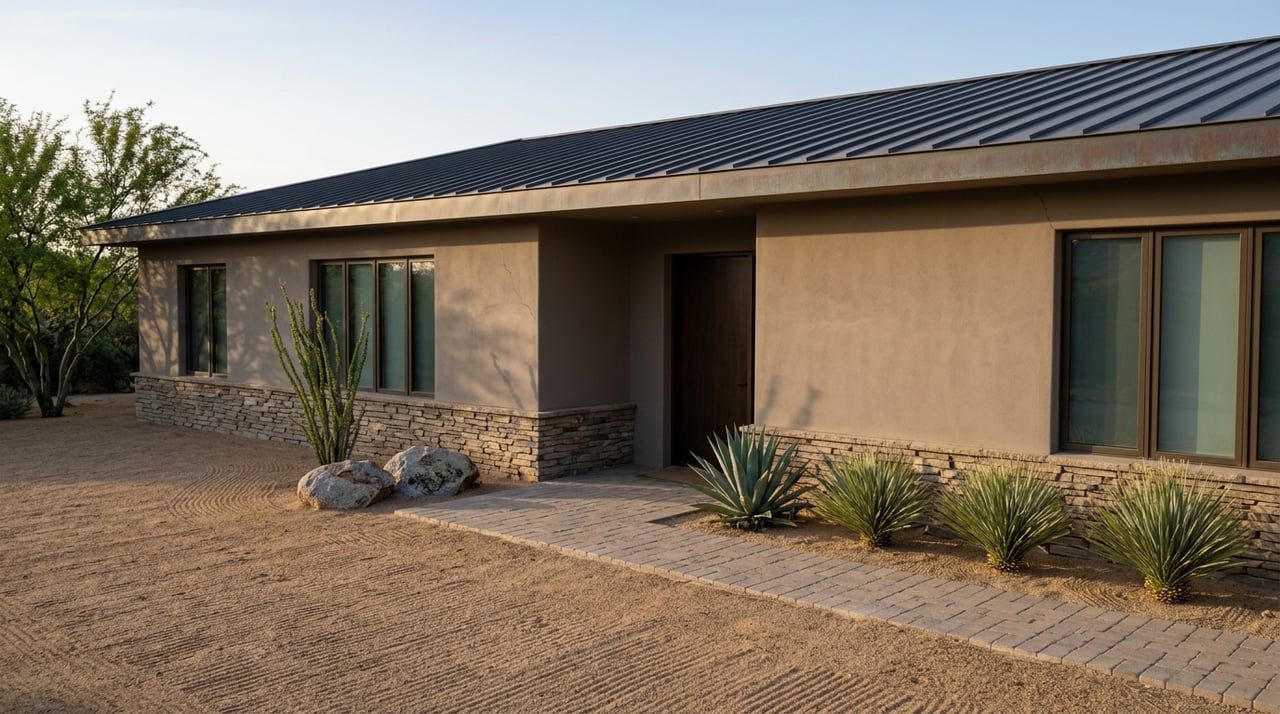
Paradise Valley's zoning code treats age as leverage. A related provision affects renovations rather than teardowns. Classic mid-century originals are found in Camelback Country Club Estates or the Cheney corridor.
None of this shows up in a comp sheet. It shows up in a pre-application meeting with the town, which is exactly where it should be resolved, before an offer, not after.
What an Acre Actually Buys You
Even without the setback trap, a one-acre R-43 lot doesn't come with a blank check. The Town of Paradise Valley caps total floor area at 25 percent of net lot area, which works out to roughly 10,890 square feet under roof on a full acre, counting living space, garage, covered patios, and any guest house. Setbacks and height limits then carve into that number before a single wall goes up. Choosing a two-story design widens the R-43 side yards from 20 feet to 40 feet, so the decision to build up instead of out costs land on both sides of the house, not just headroom.
The Town of Paradise Valley's flatland submittal requirements set maximum primary-residence height by acreage:
| Lot Size | Maximum Height |
|---|---|
| Under 3 acres | 24 feet |
| 3 to under 4 acres | 26 feet |
| 4 acres or more | 30 feet |
Hillside lots run on a different clock entirely. The Hillside Building Committee, a six-member panel of citizen appointees and rotating Planning Commissioners, reviews land disturbance, height, lighting, materials, and drainage on any sloped parcel before a permit is issued, and height there is measured against a building envelope tied to the slope, not a flat number of feet. On July 15, 2026, the committee approved a roughly 28,792-square-foot house on a five-acre hillside parcel at 5611 East Roadrunner Lane, with a maximum height near 39 feet, 9.75 inches, a figure that would blow past the flatland tiers but fit within the applicable hillside planes. According to Citizen Portal, Chair Scott Jarson's approval came with conditions attached:
"I would like to, at this time, make a motion that we approve item A26187... with the stipulations as indicated in the report adding 2 additional stipulation 1 would be applicant to provide final roof color and surface material inclusive of a sand broadcast or similar non glare topcoat material for approval by staff and chair."
He also required the applicant to swap ornamental blue gramma grass for native plants near the property edges, a reminder that hillside approval isn't just about massing. It extends to landscaping and glare. Earlier this month, the same committee approved a smaller case at 7121 North 64th Place, a redesigned second-story addition that kept the existing footprint and heights unchanged, moving through review with standard staff conditions rather than a lengthy negotiation. Two hillside cases within a few months of each other, two entirely different review experiences, because the projects asked the town for different things.
The Zip Code Is Selling At Least Three Different Products
Paradise Valley uses a single zip code, 85253, but a buyer comparing listings inside it is really comparing three or four separate markets that happen to share a boundary. Camelback Country Club Estates anchors the Tatum Boulevard corridor around the historic Paradise Valley Country Club, with mostly flat, one-acre lots and inventory ranging from original 1960s ranch homes to significant new custom builds. The Cheney corridor, central and flat, leans harder into teardown territory, where 1950s and 1960s originals often sell specifically for their rebuild potential. A third group, Clearwater Hills, Finisterre, Judson Estates, Paradise Reserve, and Azure at Ritz-Carlton, are guard-gated enclaves that carry HOA dues to fund private gate staffing and shared landscaping, a layer of governance the town's zoning code doesn't otherwise require. Azure and Paradise Reserve in particular market themselves to second-home buyers who want mountain views without the upkeep of a full acre.
The math behind a teardown purchase illustrates why these aren't interchangeable products. Land-only teardown pricing in town has run in the $2 million to $3 million range, and pairing that with a $5 million to $7 million custom build puts the combined cost well short of the $15 million-plus trophy tier. That trophy tier is its own animal. A $30 million, roughly 14,100-square-foot spec estate is under construction on a rare flat, Camelback-view lot at 5719 East Indian Bend Road, designed by architect Matt Thomas with interior designer Lauren Wallace, after a demolition permit cleared the site in January 2025. On the Casa Blanca corridor nearby, a modern estate sold for $20.9 million in an all-cash deal, and a separate sale on the same street reportedly set an Arizona record at $33.5 million. Local broker Katrina Barrett described the dynamics on that street this way:
"Lots of developers have their eye on that street, waiting to pounce when a home is listed, and many homeowners receive offers before their properties ever reach the market."
A teardown-plus-build path, a guard-gated lock-and-leave path, and a trophy off-market path are not variations on one market. They're three different products being sold under one zip code.
Why Four Sources Show Different Price Numbers
That product split is a big part of why Paradise Valley's median price looks different depending on where you check it, and none of the sources are wrong. Zillow's automated home-value estimate for the town stood at about $3.0 million as of July 2026, down 1.4 percent over the prior year, but that figure is a value estimate, not a record of actual closed sales. Redfin's own numbers moved depending on the window: over the three months ending April 2026, the reported median sale price was $4.6 million, up 3.4 percent year over year, with homes selling in about 69 days; its February 2026 snapshot showed a $6.2 million median on just 28 closed sales that month, with homes moving in 38 days. Realtor.com's March 2026 summary put the median at $5.13 million across 378 active listings and labeled the town a buyer's market. The Institute for Luxury Home Marketing's report covering December 2025 recorded 22 luxury sales at a $5.2 million median, with a 94.96 percent sale-to-list ratio.
Four sources, five numbers, all describing the same town within a matter of months. The common thread is volume. Paradise Valley closes somewhere between 20 and 60 single-family homes a month, compared to the hundreds Scottsdale or Phoenix close in the same window, and in a sample that small, one or two trophy closings can move the median by hundreds of thousands of dollars without any change in the underlying market. Layer that on top of a town selling teardown lots, gated lock-and-leave condos, and $20 million estates under the same zip code, and the median stops being a single number worth memorizing. It becomes a symptom of how few transactions are actually happening, and how different those transactions are from each other.
What To Confirm Before You Write an Offer
A buyer who wants an honest answer about a specific Paradise Valley property is better served skipping the median entirely and asking about the parcel itself:
- When was the primary structure built, and does that date fall before or after June 13, 1991, on an R-175 lot.
- Is the parcel inside the town's hillside designation, and if so, has anyone run the slope-based height envelope rather than assuming a flatland limit.
- What does the 25 percent floor area ratio actually allow on this specific lot once setbacks and any height plane are applied.
- If a remodel is planned instead of a teardown, what setback requirements may apply to the project?
- Does the address sit close enough to the 85018 or 85250 boundary that the legal address needs confirming with the town before an offer goes in.
A five-minute pre-application conversation with the town answers most of these before a contract does.
Paradise Valley rewards buyers who ask about the parcel before they ask about the price. If you're weighing a specific lot, a rebuild candidate, or a hillside estate and want a straight read on what the zoning will actually let you build there, Michael Bullis can walk the property with you and help you separate what the listing says from what the town will approve.
This article is general information, not legal, tax or financial advice. Consult a qualified professional about your situation.