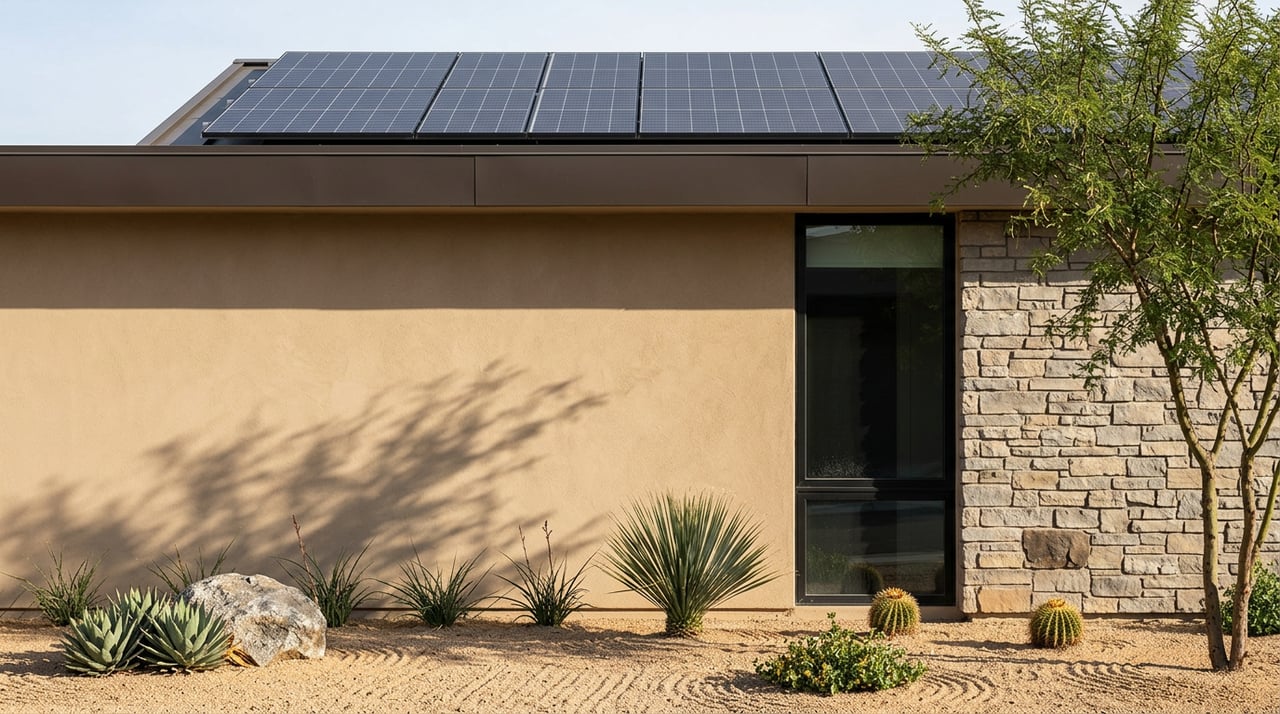
Two summers ago, a leased solar system was a paperwork nuisance. In the Phoenix market of mid-2026, it is the single most common reason a clean-looking escrow collapses in the last ten days. The math changed because the market changed. When about 26% of active listings have seen price reductions recently and buyers finally have room to walk, any friction in the file becomes leverage. Leased solar is where that friction lives.
The friction moved from price to paperwork
The Phoenix headline numbers still read as stable. The 2026 Phoenix real estate market opens with a median sale price of $413,083, up 3.5 percent year-on-year, and as of early July, the average 30-year fixed mortgage rate is hovering around 6.47%. Under those numbers, though, the sale-to-list price ratio of 98.8 percent and the fact that more than 60 percent of homes are closing below list confirm a market that has shifted, modestly, in the buyer's direction.
A buyer with options reads a solar disclosure differently than a buyer without them. A twenty-year escalating lease, a credit qualification the buyer might fail, a UCC filing the buyer's lender does not want to see. Each of those was survivable in 2022. In 2026, each is a reason to cancel inside the inspection period and take the earnest money back.
The Arizona REALTORS® spent 2025 rewriting the Solar Addendum because of exactly that pattern.
What the November 2025 Solar Addendum actually changed
The Solar Addendum will be heavily revised to address problems encountered by numerous solar companies filing bankruptcy. The changes move up the timeline for buyers to begin the process of qualifying for an assumption of a solar loan or lease. That is the short version. The longer version, for a seller, is that the addendum now forces work forward into the first days of escrow that used to happen in the third week.
Three practical shifts matter to a listing:
- Earlier assumption clock. The buyer's qualification process starts sooner, which means a listing agent who does not have lease terms, payoff quotes, and transfer instructions ready on day one has already lost time.
- A written buyer-caution step. A new clause will advise buyers to carefully review the solar lease/loan assumption approval documents they receive from the solar company (typically a few weeks into escrow) to verify that the terms match what was agreed. Any mismatch between what the seller represented and what the lessor sends is now a formal review point.
- Transfer fees and credit-score fees are negotiated up front. The addendum has documented Transfer Fees since 2022 because it has become increasingly common for Lessors to charge a Transfer Fee in conjunction with the Buyer's assumption of the Solar System lease/loan. The workgroup therefore wanted to provide the parties with the opportunity to negotiate and document who will pay any such Transfer Fee. The Credit Score Fee is the sharper edge: many Lessors require the Buyer to have a minimum credit score to obtain assumption approval. For those buyers who do not meet the required credit score, some Lessors will issue assumption approval if the Buyer agrees to pay an additional fee referred to as a Credit Score Fee. The Buyer is not obligated to pay this fee and may instead elect to cancel the Purchase Contract.
Read that last clause twice. If your buyer comes in with average credit and the lessor demands an extra fee for approval, your buyer has a contractual exit. The seller who did not surface that risk before accepting the offer is the seller who eats a re-list.
The UCC-1 problem most sellers do not know they have
Most Phoenix homeowners with leased panels have never heard the phrase "fixture filing." Their title company has. When a solar lease is put in place, the lessor typically records a UCC-1 financing statement against the property to protect its equipment. That filing needs to be handled before or at closing, or the buyer's lender will refuse to fund.
The Tesla/SolarCity process is representative of the industry approach. Addressing the UCC-1 Financing Statement: Though not a lien, a UCC-1 financing statement indicates Tesla / SolarCity's ownership of the solar system. For financing purposes, this may need to be temporarily released or subordinated, necessitating a $150 document processing fee paid by the seller. One hundred fifty dollars is not the point. The point is that no one asks the lessor to release or subordinate until title flags it, and title does not always flag it until week three.
Ask title to run the UCC search the day the listing photos are shot. If a filing exists, request the subordination form the same week. That single move recovers roughly ten calendar days of the transaction.
When the leasing company goes bankrupt mid-escrow
The 2024 SunPower bankruptcy left thousands of Arizona homeowners in a supported-but-unclear state. A Surprise, Arizona resident sold his home, transferred his SunPower lease to the new owners, and continued to receive bills at his new address for months, leading to fears of potential collection actions. This situation was exacerbated by SunPower's recent bankruptcy and subsequent service transitions to SunStrong Management, a company that was not authorized for service takeover until months after the bankruptcy.
For a Phoenix seller in 2026, two implications follow. First, if your original lessor is now serviced by a successor, the transfer documents your neighbor used are not the documents you will use. Second, the seller's clean exit at close of escrow is not automatic. Get the successor's transfer confirmation in writing, keep the acknowledgment letter, and reconcile the final billing cycle. Tesla/SolarCity, for reference, sends a final invoice within two billing cycles post-Close of Escrow on the home, covering energy produced (for PPAs) or monthly lease payments through Close of Escrow. Assume similar tails from every provider and plan the closing statement accordingly.
What Arizona law actually requires
Arizona's statutory disclosure framework sits under A.R.S. §33-422, and the practical effect for a leased solar seller is direct: the lease, the lessor's name, and the lessor's contact information belong on the disclosure at the front of the transaction, not at the buyer inspection notice. The AAR Seller's Property Disclosure Statement is for sellers to complete when offering their home for sale. This form provides an opportunity for the sellers to disclose information about the condition of the property being offered for sale and should not be completed by the REALTOR®. Although this form is not a legal requirement, the seller is obligated to complete and deliver the form to the buyer within five (5) days after contract acceptance.
There is a policy conversation going on inside the Arizona REALTORS® about whether solar terms should be surfaced even earlier. Could the SPDS include a clear summary of the solar lease terms (payment amount, escalators, years remaining)? Aaron acknowledged this suggestion is very practical. He shared that AAR's forms committee has noted the idea, and they may consider adding a solar-specific question or attachment to the SPDS in a future cycle. (This wouldn't be in the November 2025 release, but possibly next year.) Until that lands, the seller who volunteers a one-page solar summary before offer acceptance is the seller who converts more offers into closings.
The pre-listing checklist that keeps solar out of the disapproval notice
Before the sign goes in the yard, get these on file:
- The full lease or PPA agreement, with contract start and end dates, monthly payment, and any escalator clause spelled out.
- A written payoff quote and a written buyout quote from the lessor, dated within the last thirty days.
- The lessor's transfer packet, including the exact minimum credit score, transfer fee, and any credit-score fee.
- A title search for a UCC-1 fixture filing, and if one exists, the lessor's subordination or release procedure.
- Twelve months of utility bills showing net production, so the buyer sees what the panels actually offset.
- A one-page seller summary attached to the SPDS in plain English.
None of that is exotic. It is a Tuesday-afternoon phone call and a folder. The reason it matters is that in a slower market, the sellers who prepare the folder close, and the sellers who improvise negotiate against themselves for two extra weeks.
Short FAQ
Can I just pay off the lease at closing and hand over an owned system? Often yes, and in a buyer-hesitant market it is worth pricing. Owned systems, by contrast, add to your home's value and rarely complicate the sale. Compare the buyout quote against the concession you would likely give a buyer who balks at the lease. Sometimes the math favors the buyout.
Will the panels appear in the appraisal? Only if you own them. If you own the solar system, yes, it can be part of the home's appraised value. If you don't own it, it usually isn't included in the property's value.
How long does the transfer process actually take? Plan on multiple weeks from the day the buyer submits the assumption application. Start on day one of escrow, not day fourteen.
If you are thinking about listing a Phoenix home with leased panels this fall, the useful conversation happens before the photos, not after the first offer. Michael Bullis Real Estate will pull the UCC search, request the payoff and transfer packet from your lessor, and price the buyout against likely buyer concessions before the sign goes up. Request Your Home Valuation to start that conversation.